Roof Waterproofing & Painting Singapore
Two jobs, one access setup. Leak repair and waterproofing stop water getting in; pressure washing, sealing and recoating restore the surface. Doing both in one mobilisation avoids paying for the lift twice.
- Painting a roof does not stop a leak. Leaks come from cracked tiles, failed ridge pointing, failed flashing or blocked valleys — each repaired as its own work.
- Access equipment is usually the biggest line on the quote, which is why leak repair and recoating are worth doing in one mobilisation rather than two.
- A stain inside is often metres from where water actually enters — water travels along battens and rafters before it drops, so the entry point is traced before anything is patched.
- Almost every roof coating failure is preparation, not paint: coating over live moss, an unsealed surface, or tiles still damp from washing will lift within a season.
Roof Waterproofing and Painting — Two Different Jobs, One Access Setup
These get confused constantly, so it is worth being blunt: painting a roof does not stop a leak. Coating restores the surface and sheds water off sound tiles. A leak comes from a cracked tile, failed ridge pointing, a failed flashing or a blocked valley — and no amount of paint over the top will fix any of those. It only hides them until the next heavy rain.
They belong together for a practical reason instead. On most roofs the single largest cost is not paint or membrane — it is getting up there safely. Boom lift, scissor lift or scaffold is frequently the biggest line on the quote. If the roof needs both leak repair and recoating, doing them in one mobilisation means paying for that access once rather than twice.
So the order matters: find and fix the water entry first, then wash, treat, seal and coat. Coating first and repairing later means cutting into a finish you have just paid for.
What Roof Waterproofing and Painting Covers
| Area | Typical Scope |
|---|---|
| Leak investigation | Water travels along battens and rafters, so it rarely enters where it appears inside. Entry point traced before anything is repaired |
| Tile replacement | Cracked, slipped and broken tiles replaced — the most common single cause of a pitched roof leak |
| Ridge and hip pointing | Loose ridge caps re-bedded and re-pointed with a flexible compound rather than rigid mortar that cracks again |
| Flashing | Failed flashing at wall abutments, parapets and penetrations replaced and dressed in properly |
| Valley gutters | Cleared, repaired or replaced — a blocked valley backs water up under the tiles above it |
| RC and flat roof membranes | Cracks treated, surface primed, then a PU or acrylic membrane and a protective topcoat |
| Falls and ponding | Standing water on a flat roof corrected with screed so the roof actually drains to its outlets |
| Water testing | Ponding or hose test after waterproofing works, before any coating goes on top |
| High-pressure washing | Moss, algae, lichen and chalking stripped back to sound tile |
| Anti-fungal treatment | Biocide applied to kill spores in the pores of the tile, so regrowth does not push the coating off |
| Sealer and topcoats | Sealer to bind the porous surface, then two topcoats for even coverage |
| Gutters, downpipes and clearance | Flushed of washed-off debris; surroundings and overspray protection cleaned down |
What Affects Roof Waterproofing and Painting Cost
| Factor | Why It Matters |
|---|---|
| Access equipment | Boom lift, scissor lift or scaffold — frequently the largest single line, and the reason to combine waterproofing and painting in one visit |
| Roof area and pitch | The base measure. Steeper roofs slow every stage and change the access method |
| Extent of leak repair | Replacing a few tiles is minor. Re-pointing every ridge and hip, or replacing flashing runs, is a different scale of work |
| Tile or slab condition | Widely cracked tiles, or a slab with structural cracking, may need more than a coating can deliver |
| Degree of growth | Heavy moss and lichen take far longer to wash and need stronger treatment than a roof that is simply faded |
| Membrane type | PU, acrylic and cementitious systems differ in cost, life and how much surface preparation they demand |
| Surroundings | Roofs above carparks, walkways or neighbouring units need more masking and screening against overspray |
| Weather window | Rain stops work, and coating cannot go over a damp roof. A wet period means more mobilisations for the same scope |
How the Process Works
- Site visit and leak trace — Roof inspected, tile type confirmed, entry points traced, access method decided
- Written quotation — Waterproofing, tile replacement, access equipment and coating priced as separate lines, with exclusions stated
- Protection — Cars, walls, landscaping and neighbouring property screened; gutters checked
- Repairs first — Tiles replaced, ridges re-bedded and pointed, flashing renewed, valleys cleared or replaced
- Membrane where required — Cracks treated, primer applied, membrane and protective coat laid on RC or flat sections
- Water test — Ponding or hose test to confirm the roof is watertight before any decorative coating
- High-pressure wash — Full roof washed top-down to sound tile
- Anti-fungal treatment and drying — Biocide applied, then the roof left to dry through — not just on the surface
- Sealer and two topcoats — Even build across every slope
- Clean-down and handover — Debris cleared, gutters flushed, joint inspection with you
Timeline — Weather Sets the Programme
The working days are predictable. The weather is not. Coating cannot go on in rain, and it cannot go over a roof still damp from the last downpour, so a Singapore roof programme always carries weather contingency.
The wash and the drying period between washing and coating are the longest stages, and the two most often skipped by a cheap quote. Waterproofing repairs add days before that, because they come first and are water-tested before anything is coated over them.
As a working reference, we have completed a full industrial roof in one week — washing, waterproofing and painting, start to finish. Larger roofs are not proportionally slower, because more area can be worked at once; small, steep or awkward-access roofs often take longer per square metre than a big open one.
A Completed Roof Project
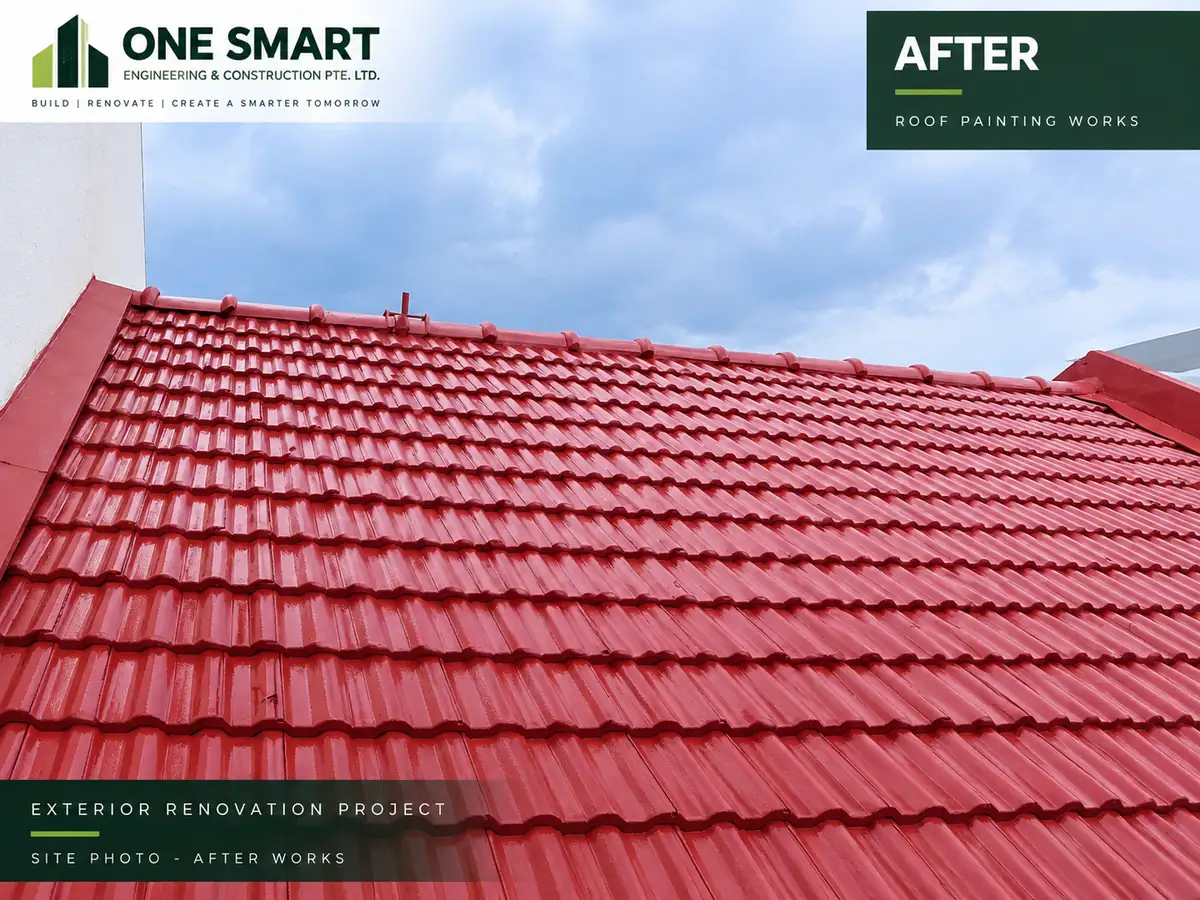
Concrete tile roof on a recent job. The roof carried heavy moss and algae growth with the original tile colour largely weathered away. It was pressure washed back to sound tile, treated against regrowth, allowed to dry, sealed and finished in two topcoats.
The before photograph was taken during the wash, which is why part of the roof is already clean while the rest still carries the growth. That contrast in a single frame is the clearest illustration of what the preparation stage actually removes — and why a roof coated without it does not last. Access was by boom lift, over a carpark, so overspray screening was set up before any coating began.
The job: an industrial building, completed in one week — pressure washing, waterproofing and painting within a single mobilisation.
Who Needs This
- Landed property owners with a leaking, faded or moss-stained tile roof
- Owners with ceiling stains or damp patches after heavy rain, where the source has not been found
- Commercial and industrial buildings with large roof areas, RC flat roofs that pond water, or roofs that have started leaking
- Owners preparing to sell or let, where roof condition shapes the first impression of the building
- Anyone quoted for a full re-roof who wants to know whether repair and recoating would do instead
- Property managers maintaining a block to a consistent standard

Roof Waterproofing & Painting FAQ
Does roof painting stop leaks?
No. This is the single most common misunderstanding, and any contractor who tells you otherwise is overselling. Coating restores appearance and sheds water off sound tiles. Leaks come from cracked tiles, failed ridge pointing, failed flashing or blocked valleys, and each is repaired as its own work. Painting over an active leak hides it until the next heavy rain.
Why fix the leak and paint at the same time?
Because access is usually the biggest cost. Boom lift or scaffold is frequently the largest line on a roof quote, so doing repairs and recoating in one mobilisation means paying for it once. It also gets the sequence right — repairs first, water test, then coating over a roof you know is sound.
The stain inside is in one corner. Is the leak there?
Usually not. Water entering a pitched roof travels along battens and rafters before it drops, so the internal stain is often metres from the entry point. That is why the leak is traced before anything is repaired — patching directly above the stain is the classic way to spend money and still have a leak.
Why does roof paint peel after a year?
Almost always preparation. Coating applied over live moss, over a chalky unsealed surface, or over tiles still holding water from the wash will lift. The wash, the anti-fungal treatment, the drying period and the sealer are the four stages that decide how long a roof finish lasts, and they are exactly what a low quote leaves out.
Can old tiles be repaired and painted, or do they need replacing?
If the tiles are structurally sound — not crumbling, not widely cracked — repair and recoating costs far less than re-roofing and restores the appearance completely. Individually broken tiles are replaced first. We tell you which situation you are in at the site visit, not after starting.
What about a flat concrete roof?
Different system, same principle. Cracks are treated, the surface primed, then a PU or acrylic membrane and a protective topcoat applied. Where water ponds instead of draining, the falls are corrected with screed first — a membrane over standing water fails early.
Will the spray get onto my car or my neighbour's property?
Not if the site is protected properly. Cars, walls, landscaping and adjacent units are screened before spraying starts. This matters most above a carpark or close to a neighbouring building, and it is worth confirming your contractor has allowed for it.
Do you do internal waterproofing too?
Yes — bathrooms, wet areas, planter boxes and balconies are covered on our waterproofing page. This page is specifically about roofs: tiles, ridges, flashing, valleys and flat roof membranes.
Other Renovation Services
Get a Free Site Visit & Itemised Quote
We measure on site, then send a fully itemised quotation within 3 working days. No obligation, no hidden charges.